Product
LaptopFinder.cc
LaptopFinder.cc is a concise, jargon-free laptop advice site aimed at students, design learners and professionals in India. It pairs short, practical guides with a chat-based advisor ('Chip') and a searchable index to recommend laptops by user role and use case.
Published
Overview
LaptopFinder.cc is a focused product that simplifies the laptop buying decision for people doing creative work. The site combines short, practical guides, a searchable article index and a lightweight conversational assistant (branded as “Chip”) that asks a few quick questions to suggest suitable laptops for different needs.
Context
Choosing a laptop for design, media or study is noisy — specs are technical, marketing is noisy and warranty/availability differs across markets. The site positions itself as "simple, honest laptop advice", aiming to translate technical options into pragmatic choices for users in India and similar markets.
1 / 3
Challenge
The core problem is decision friction: people waste time comparing specs or end up choosing devices that don’t match their workflows. The product needed an experience that reduces options into clear, role-based recommendations without overwhelming the user.
Approach
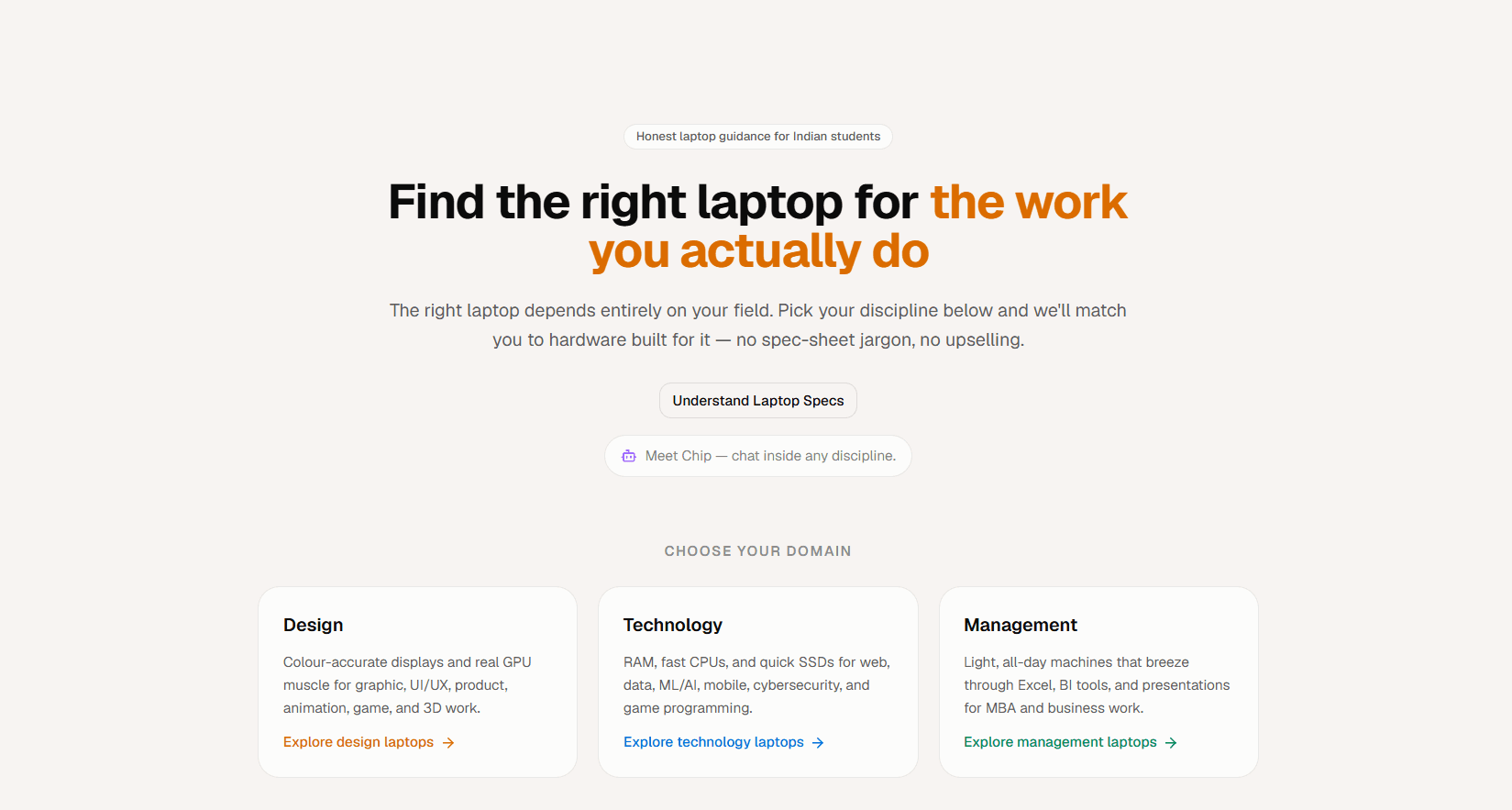
The homepage leads with a direct value proposition and a prominent "Find My Laptop" CTA. Content is organised as short guides and searchable posts (e.g. warranty guides). The conversational assistant asks a small set of questions (examples visible in attached screenshots: "Design aspirant", "Design student", "Working professional") and routes users to recommendations or relevant articles — a mix of algorithmic filtering and editorial guidance.
Contribution
LaptopFinder.cc reduces cognitive load by pairing concise editorial content with an interaction-first recommendation flow. The attached cover screenshot signals the site’s voice and target audience at a glance; gallery images document the chat-based assistant and interface patterns used to surface recommendations.
Outcome
The site publishes practical guides and an interactive advisor. The current evidence (screenshots attached to this draft) shows the product’s structure and interaction model. Specific performance metrics, launch timeline and team credits are not yet recorded here.
Reflection
This work sits between product strategy, information architecture and UX: small, focused content pieces and a simple conversational surface aim to make buying easier. Potential next steps include capturing user feedback data, refining the advisor’s recommendation rules, and expanding guides for different device classes and budgets.